

If a wisdom tooth seems to appear, disappear, then show up again weeks later, the question is a reasonable one. Wisdom teeth do travel in two directions, though not in the way the question usually means. Upper ones move down, and lower ones move up, and neither retreats into the jaw once it has started. What changes between one week and the next is usually the gum over the tooth, not the tooth itself. In this blog post, we cover which way wisdom teeth move, why they seem to come and go, what impaction means, and when wisdom teeth removal is recommended.
Quick Overview
- Wisdom teeth in the top jaw erupt downwards, and those in the lower jaw erupt upwards, so as a set they do go both ways.
- An individual tooth moves in one direction only, and it does not sink back into the jaw bone.
- A gum flap over a partially erupted tooth swells and settles, which is what looks like the tooth moving.
- Lower wisdom teeth take longer to come through and are more likely to become impacted.
The direction a tooth travels depends on which jaw it sits in.
Which Way Wisdom Teeth Actually Move
Wisdom teeth are the third molars, sitting at the back of the mouth behind the second molars. They are the last adult teeth to arrive, generally appearing in the late teens to early twenties, between about 18 and 25 years of age.
Four wisdom teeth is the usual number, two in the top jaw and two in the bottom. Not everyone develops all four. Some develop one, two or three, and some develop none at all.
Direction follows position. A tooth in the upper jaw erupts downwards, and one in the lower jaw erupts upwards. Both are moving from inside the jaw bone towards the biting surface. So the literal answer is yes, wisdom teeth go up and down, just not the same tooth doing both.
What they do not do is reverse. Once a tooth has begun moving towards the surface, it does not withdraw into the bone. Eruption can stall, and it can stop altogether, but it does not run backwards.
There is one exception worth knowing. A wisdom tooth can grow too long, which is called over-eruption. This happens where there is no opposing tooth to meet, so nothing stops the tooth continuing. An over-erupted tooth can grow out far enough to damage the cheek or the gum opposite it.
Why It Can Feel Like Back-and-Forth Movement
This is the part that explains what you have been noticing.
When a wisdom tooth only partly erupts, it often leaves a flap of gum lying over part of the crown. That flap is the source of the apparent movement. It traps food debris and bacteria underneath; the gum tissue becomes inflamed and swells, and less of the tooth is visible. When the inflammation settles, the swelling reduces, and more of the tooth shows again.
The inflammation has a name. Pericoronitis is an infection of the gum around a partially erupted tooth, and it tends to recur instead of resolving once and for all. Each flare-up brings swollen gums, sometimes a bad taste or bad breath from the trapped debris, and sometimes sharp pain on biting. Between flare-ups, the area can feel close to normal.
Eruption itself is also uneven. A tooth can move a little, pause for months, then move again. Combine that stop-start pattern with a gum flap that swells and settles, and a tooth can genuinely seem to come and go over a year or more.
What Impaction Means, and Why Lower Teeth Differ
An impacted wisdom tooth is one where something is stopping it from pushing all the way into the mouth.
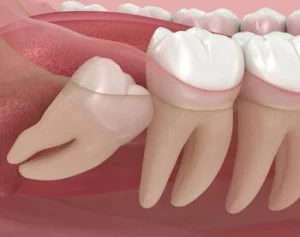 The usual obstacle is space. Many jaws do not have enough room or enough space for wisdom teeth to move through the gum line cleanly, so the tooth stalls partway. The other obstacle is angle. A tooth sitting on a tilt can bump into the second molar in front of it, and that contact stops it from going further. Either way, the tooth sits under the gum or only partly through it, with a small portion visible.
Lower wisdom teeth behave differently from upper ones. Teeth in the lower jaw take longer to come through and carry a higher risk of becoming impacted, which also makes repeated infections more likely in that area.
Impacted teeth can cause dental problems whether or not you feel them, and left untreated, those problems tend to compound. That is why an impacted tooth is followed over time instead of ignored. Food gets trapped, tooth decay can develop on the wisdom tooth or on the second molar it is pressing against, and cysts can form around the tooth. Decay on the second molar is the more consequential of the two, since that tooth is one you need to keep. Some impacted wisdom teeth cause nothing at all for years, which is why they are monitored with X-rays rather than assumed to be fine.
Symptoms Worth Reporting
Erupting wisdom teeth cause pressure in the area, and mild awareness of that is expected. Some signs are worth an appointment.
- Swollen gums at the back of the mouth, particularly where the swelling comes and goes.
- Sharp pain on biting, which can mean the gum flap is being caught between teeth.
- Bleeding gums around the last tooth when you brush or floss the area.
- Jaw pain or stiffness, including difficulty opening fully.
- Bad breath or a persistent bad taste that cleaning does not shift.
- Facial swelling or fever, which needs prompt attention, not a routine appointment.
Keeping the area clean matters while a tooth is coming through. A toothbrush with a small head reaches further back. Keeping your mouth partly closed while brushing gives more room around the outer side of the tooth. An antibacterial mouthwash helps when the gums are too sore to brush properly, though it does not replace brushing.
Do Wisdom Teeth Make Other Teeth Crooked?
The evidence does not support this, despite how widely it is believed.
Wisdom teeth pushing into the mouth create a feeling of pressure, and it is understandable to assume that pressure is shifting the teeth in front. There is currently no evidence that wisdom teeth cause other teeth to become crooked.
That matters if you have had orthodontic treatment. Crowding that appears years afterwards is a recognised pattern with its own causes, and removing wisdom teeth to prevent it is not supported. Where wisdom teeth are removed as part of orthodontic treatment, the reason is usually to create room to move other teeth backwards, which is a different objective.
When Removal Is Recommended
Not all wisdom teeth need to be removed. Where they have erupted fully, sit in a cleanable position and cause no problems, they are left alone and monitored.
Whether a tooth needs removing depends on that tooth’s position and condition. Removal is recommended for reasons including:
- the tooth is impacted and cannot move into the mouth
- the gum around it has been infected repeatedly
- there is tooth decay in the wisdom tooth or the tooth in front of it
- the tooth is at high risk of decay or gum disease because of its position
- a cyst has formed near or around it
- the tooth has over-erupted and is damaging the cheek or gum
- space is needed to move other teeth backwards as part of orthodontic treatment
Timing matters. Wisdom teeth causing problems, or at high risk of causing them, are more straightforward to remove at a younger age. Removal by around 25 is less complicated than later. Leaving a symptomatic tooth carries its own risk, since symptoms tend to return, and a serious infection can develop.
What Removal Involves
Wisdom tooth extraction is carried out by your dentist.
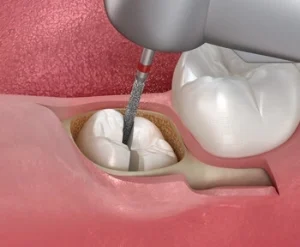 Upper wisdom teeth are usually removed under local anaesthesia without difficulty. Lower teeth can be harder, particularly when impacted, and a sedative or general anaesthetic may be offered. The procedure can involve a cut in the gum and removing a small amount of jaw bone with a drill. The tooth may also be sectioned into pieces so it comes out through a smaller opening.
Afterwards, a blood clot forms in the extraction site and protects the healing socket. Protecting that clot is the main job of the first two days, so leave the area alone, avoid rinsing vigorously, and skip smoking and straws. Losing it early is what causes a dry socket. A soft diet is sensible while the site is tender. Minor bleeding on the first day is expected, and firm pressure with clean gauze settles it.
Complications are uncommon and will be explained to you beforehand. They include dry socket where the clot is lost, jaw stiffness, damage to nearby teeth, and sinus problems with upper teeth. Altered sensation in the lip or tongue can follow lower extractions, and it is usually temporary. Recovery to normal activity generally takes about a week.
Book an Assessment If a Wisdom Tooth Is Bothering You
A wisdom tooth that appears and disappears is worth having looked at, because the pattern usually points to a gum flap and recurring infection rather than to a settled tooth. At Boutique Dental Care, we assess the position of your wisdom teeth with an X-ray. That shows the angle, the roots, and how close the tooth sits to nearby nerves. From there, we can tell you whether the tooth needs removing, or whether monitoring is the sensible course for now. To arrange an appointment, please call us on (02) 9054 5281.
Frequently Asked Questions
Can a wisdom tooth stop coming through and stay where it is?
Yes, and that is common. A tooth can move partway, meet an obstruction, and remain in that position indefinitely without ever fully erupting. It is not stuck in the sense of being trapped mid-movement; it has simply reached the limit of the space available to it.
How long does a wisdom tooth take to come through?
Longer than patients tend to expect. Full eruptions can take months to a few years, with visible progress in some periods and none in others. That extended timeline is part of why the process feels like it starts and stops.
Do wisdom teeth need removing if they are not hurting?
Not automatically. Pain is one indication among several, and a tooth can be causing decay in the tooth in front without hurting at all. That is what an X-ray answers, and it is why we check the position even when nothing is sore.
Can I have all four removed at once?
Often, and there are reasons to consider it, including a single recovery instead of several. It depends on the difficulty of each tooth and the type of anaesthesia used. We will talk through whether staging them makes more sense in your case.
Is it normal for only one wisdom tooth to come through?
Yes. The four teeth do not develop or erupt on the same schedule. It is common to have one fully through, one partly through, and others that never appear. Each tooth is assessed on its own position.
Any surgical or invasive procedure carries risks. Before proceeding, you should seek a second opinion from an appropriately qualified health practitioner.
References
https://my.clevelandclinic.org/health/treatments/22119-wisdom-teeth-removal
https://www.ncbi.nlm.nih.gov/books/NBK279590/