

The types of crooked teeth cover more than one kind of problem. Some teeth twist in place, some overlap their neighbours, some sit too far forward, and some are the wrong size for the space. Knowing which pattern you have makes it easier to follow what your dentist explains and what your teeth straightening options might involve.
Crooked or misaligned teeth are a common dental issue covering two things: tooth position and how your upper and lower teeth meet.
Quick Overview
- Crooked teeth cover both single teeth out of line and upper and lower teeth that do not meet evenly.
- Crowding comes from a mismatch between jaw size and tooth size, leaving too little room for every tooth.
- Genetics, childhood habits, missing teeth and teeth grinding all influence where teeth end up.
- An assessment shows which type you have, and treatment options range from clear aligners to surgery in severe cases.
Below, we cover each type of crooked tooth, each type of bite, and what straightening involves.
What counts as crooked teeth?
Crooked teeth can mean teeth that sit out of line, overlap, twist or leave gaps. Once the way you bite is included as well, the whole picture is called malocclusion.
In a well-aligned mouth, the upper teeth overlap the lower teeth slightly, and the back teeth fit into the grooves of the teeth opposite.
Types of crooked teeth you can see
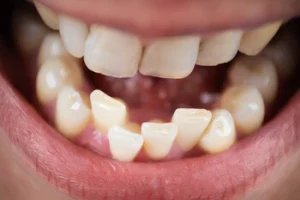 Four patterns cover most of what you will see: crowding, rotation, spacing and misshapen teeth.
Crowding affects upper and lower teeth alike. When teeth overlap, a tooth sits in front of or behind its neighbour.
Rotated teeth are turned in the socket rather than pushed out of line, so the tooth faces sideways. Tilted teeth lean towards a neighbour, which tends to happen beside a gap.
Spacing is the reverse: gaps open where the teeth are too small for the jaw they sit in.
Misshapen teeth are an unusual size or shape from the start, such as narrow upper lateral incisors. Even with every tooth in position, severely misshapen teeth leave the line looking uneven.
When the bite does not line up
Bite problems are about how the upper and lower teeth meet, rather than about a single tooth. In an overbite, the top teeth cover the bottom teeth too deeply. An increased overjet is different, because the upper teeth sit forward horizontally instead of sitting down over the lower ones.
In an underbite, the lower teeth sit in front, and in a crossbite, some upper teeth bite inside the lower ones. In an open bite, the front teeth do not touch while the back teeth are together.
In one study of patients with jaw joint symptoms, upper teeth sitting well ahead of the lower teeth were linked with more jaw pain and limited opening, and with soreness in the jaw muscles. Misalignment on its own has not been shown to cause temporomandibular joint problems.
Why teeth grow crooked
Crowding happens when there is not enough room in the jaw for every tooth, whether because the teeth are large, the jaw is small, or both. Spacing forms the other way around, and the mismatch is often inherited.
Habits during childhood matter too. Thumb sucking presses against developing teeth over several years, and it can push the upper front teeth forward. Tongue thrusting is another habit your dentist will ask about. Losing baby teeth early lets surrounding teeth drift before the permanent teeth arrive, and missing teeth in adulthood do the same. Teeth grinding wears the biting surfaces unevenly.
How crooked teeth affect oral health
Crooked teeth are harder to keep clean, and that is the main concern. Overlapping surfaces hold plaque where a toothbrush and floss struggle to reach, however careful your oral hygiene is.
Plaque left in those spots can raise the risk of tooth decay and gum disease, and misalignment is also linked with uneven wear and difficulty chewing.
 What straightening involves
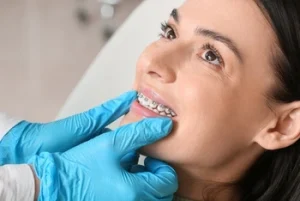
Treatment options depend on your type of crooked teeth and how far they need to travel. Most orthodontic treatments apply light, steady pressure so teeth shift gradually into a new position.
Clear aligners are a removable option for many alignment problems, and Invisalign aligners are one of the systems your dentist may discuss. They are made from digital scans, and each stage moves specific teeth slightly. Where the jaws themselves sit out of position, a plan can involve teeth straightening surgery, a form of oral surgery your dentist would talk through in detail before anything is decided.
Talk to Boutique Dental Care about crooked teeth
Crooked teeth often go unchecked for years, and plaque collects where they overlap. An assessment at Boutique Dental Care covers which type of crooked teeth you have, how your upper and lower teeth meet, and whether the alignment is affecting the health of your teeth and gums. Your dentist can talk you through the approaches that suit your case, at a pace that suits you. If you would like your teeth assessed, please call us on (02) 9054 5281.
Frequently Asked Questions
How can I tell which type of crooked teeth I have?
Crowding and gaps are easy to spot in the mirror, but the way your upper and lower teeth meet is hard to judge on your own. A check-up with photographs and X-rays shows tooth position and bite together, and your dentist can talk you through the images.
My child still has baby teeth. Is it too early to check their alignment?
No, it is not too early. At routine visits, your dentist watches how your child’s teeth come through and how the jaws are growing, and will tell you if something needs monitoring rather than treating.
How long does straightening crooked teeth take?
That depends on how far the teeth need to move and which type of alignment problem you have, so an accurate answer comes after an assessment. Your dentist will give you a timeframe before treatment starts.
Does private health insurance cover teeth straightening?
Many extras policies include orthodontics, though waiting periods and limits vary between funds, so it is worth checking your own cover before you begin. Ask us for the costs in writing to check against your policy.
Do I need a referral before having crooked teeth assessed?
No referral is needed. You can book an assessment with us directly, and we will explain what we find and your options at that appointment.
References
https://orthodonticsaustralia.org.au/what-is-a-malocclusion/
https://www.healthdirect.gov.au/orthodontic-treatments