

If you have ever turned a toothpaste box over and wondered how much fluoride in toothpaste is right for your family, the number you want is printed near the ingredients. Fluoride levels are measured in parts per million, shortened to ppm on most packaging, and that figure decides how much protection the paste gives your teeth.
The right strength is not the same for everyone. Age is the main factor, though your own risk of decay matters too. A toddler learning to brush needs something different from an adult managing dry mouth or gum disease. This guide sets out the strengths sold in Australia, the amount of toothpaste to use at each age, why dental fluorosis happens, and what to raise at your next routine dental check-up.
Quick Overview
- Toothpaste sold in Australia comes in three broad strengths: low fluoride for young children, standard strength from six years, and higher concentrations supplied on dental advice.
- Fluoride is a natural mineral that hardens tooth enamel against the acid attacks behind tooth decay.
- Children aged 18 months to five years need only a pea-sized amount of low fluoride toothpaste, and children under 18 months need none at all.
- Excess fluoride while adult teeth are still forming can cause dental fluorosis, which in Australia is almost always mild.
Below, we look at the numbers on the packet, the amount to use at each age, and when a different strength makes sense.
How much fluoride is in toothpaste?
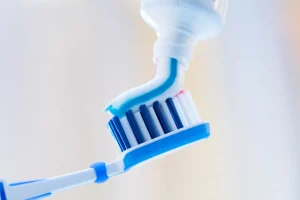 Toothpaste sold in Australia falls into three groups. For young children, low fluoride toothpaste holds around 500 ppm fluoride. Standard fluoride toothpaste, used by older children and adults, holds 1000 to 1450 ppm. A third, higher strength exists for specific clinical situations.
Finding that number takes a moment. Some brands print parts per million directly, while others list milligrams per gram, so 1 mg/g is the same as 1000 ppm. Under the ingredients, you will find the active compound, usually sodium fluoride, sodium monofluorophosphate or stannous fluoride.
How fluoride strengthens tooth enamel
Fluoride is a naturally occurring mineral found in rocks, soil, tea and water. It works on the tooth surface rather than inside the body, which is why toothpaste counts as a topical fluoride.
Every time you eat or drink something sugary, bacteria in dental plaque turn that sugar into acid. Those acid attacks pull mineral out of tooth enamel, and when that happens often enough, they cause dental caries. Fluoride interrupts the cycle in three ways. It slows the loss of mineral, it helps mineral return to enamel where early decay has begun, and it disrupts bacterial metabolism so plaque produces less acid.
How much fluoride toothpaste should children use?
Children under 18 months need no toothpaste at all, just a soft brush and water. From 18 months to five years, use a pea-sized amount of low-fluoride toothpaste twice a day, in the morning and before bed. From six years, children move to standard fluoride toothpaste.
The amount matters as much as the strength, because young children swallow some of what goes on the brush. A pea-sized amount of toothpaste limits how much fluoride they take in. Extra paste adds nothing.
Supervision matters just as much as the amount. It helps to supervise brushing until seven or eight, by which age most children can manage the brush and spit reliably. Encourage them to spit the paste out rather than swallow it.
What is dental fluorosis, and how likely is it?
Dental fluorosis is a change in the appearance of adult teeth caused by too much fluoride while those teeth are forming under the gums. It usually shows as fine white lines or flecks. In Australia, it is almost always very mild or mild.
Once the teeth have come through, fluorosis can no longer develop. The biggest risk factor is incorrect toothpaste use in young children, which is why the low fluoride range and the pea-sized amount exist. Keep tubes out of reach so a small child cannot eat paste from the tube, and stick to the amount set for their age. Used at those amounts, fluoride is regarded as safe by Australian health authorities. Mild fluorosis does not affect how the teeth work or how they look, and its appearance can fade over time.
Do adults ever need a different fluoride strength?
Most adults do well on standard fluoride toothpaste, used twice a day. Some situations raise decay risk enough that your dentist recommends a higher concentration paste, or professional fluoride treatments applied in the chair.
Factors that raise your risk of dental decay include dry mouth, a side effect of some medications and medical conditions, and gum disease, which exposes more of the tooth surface to bacteria. Dental erosion from reflux or acidic drinks, tooth sensitivity from worn enamel or exposed roots, and having crowns, bridges, dentures or braces all make surfaces harder to keep clean.
Higher concentration dental products are matched to a specific problem, so your dentist would recommend one after examining your teeth and history. In-chair treatments are applied as a varnish, foam or gel.
How fluoridated water fits alongside toothpaste
 Most Australian community drinking water has fluoride added, at a level far below anything in toothpaste. Both matter, for different reasons. The water supply keeps a low level of fluoride in the mouth through the day, while brushing delivers a short, stronger dose twice daily.
If you drink tank water or filtered water, your fluoride exposure may be lower than you assume. Some filters strip fluoride out, and some leave it, so check the product details before relying on it. If you buy bottled water, check the label for fluoride content, as it varies between brands. Fluoride drops and tablets are no longer recommended in Australia, so toothpaste strength is the practical thing to discuss with your dentist. Without fluoridated water at home, your dentist may suggest brushing three times a day.
Talk to Boutique Dental Care about the right toothpaste
Choosing a fluoride strength is far easier when we have looked at your teeth and know your decay history. At Boutique Dental Care, we check enamel for early decay, weigh up the factors that raise your risk, and match a toothpaste strength to you or your child. If low fluoride toothpaste is still right for your five-year-old, we will say so, and if a higher concentration suits you better, we will explain why. To talk it through, please call us on (02) 9054 5281.
Frequently Asked Questions
Is fluoride-free toothpaste worth using?
Fluoride-free pastes still lift plaque from the tooth surface, but nothing in them replaces what fluoride does for enamel. If you would rather avoid fluoride, tell us at your visit. We can weigh up your decay risk and explain what the trade-off looks like.
Should I rinse with water after brushing?
No. Spit out the excess paste and stop there, because rinsing washes away the thin layer of fluoride that keeps working on the tooth surface afterwards. Rinsing also makes it easier for a young child to swallow what is left in their mouth.
What should I do if my child swallows a lot of toothpaste?
A small swallow during brushing happens often and is not a cause for concern. A larger amount is a different matter, and we would rather you called us straight away than waited. Tell us roughly how much and when, and we will talk you through the next step.
Can young children use a fluoride mouth rinse?
Fluoride mouth rinses are not recommended under six years unless we have advised one, because children that age are more likely to swallow them and take in excess fluoride. There is also little to gain at that age when toothpaste is being used correctly. From six years, ask us whether a rinse would add anything for your child.
Do whitening and sensitivity toothpastes contain enough fluoride?
Most do, though not all, so check the concentration on the box rather than assuming. A whitening or sensitivity paste at full strength helps prevent tooth decay just as a plain standard paste does. If a product does not list a fluoride level, treat it as fluoride-free.
References
https://teeth.org.au/dental-fluoride
https://www.healthdirect.gov.au/tooth-decay